Dathsom Script Typeface for Handmade Creators
As a maker who designs printable wall art, sews boutique gift tags, cuts vinyl stickers for small-batch candles, and crafts wedding welcome boards for local couples—I’ve learned that the right script font doesn’t just look pretty. It builds trust, signals care, and quietly tells your customer, “This was made with intention.” That’s why Dathsom has become my go-to script typeface in the Script Amp category—not because it’s flashy, but because it’s reliably expressive.
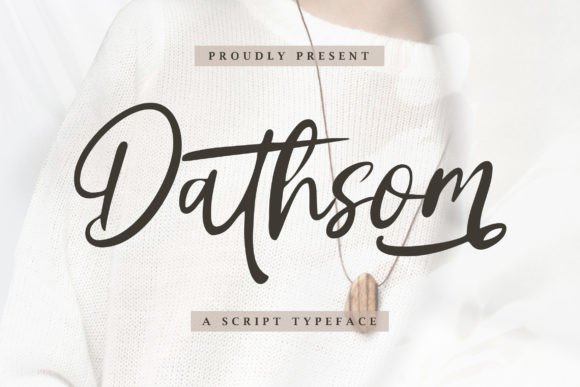
Dathsom is a fluid, graceful script font with subtle bounce and organic rhythm. Its strokes taper thoughtfully, its connections feel natural—not forced—and its personality lands somewhere between modern elegance and warm approachability. It’s not overly ornate like some vintage scripts, nor too minimalist to hold presence at small sizes. That balance makes it uniquely useful across physical and digital product formats.
I use Dathsom most often for short, high-impact phrases: “Hand-poured,” “Small Batch,” “Made With Love,” or “Est. 2022” on kraft paper labels. On candle jars, those words in Dathsom instantly elevate perceived value—no extra design flourishes needed. The font’s open letterforms and consistent spacing also cut cleanly on Cricut and Silhouette machines, even at 12–16 pt for 1.5" sticker labels. I’ve tested it down to 8 pt on matte vinyl, and it remains legible when held at arm’s length—a rare win for any script font.
For wedding stationery, Dathsom shines on invitation suites where readability meets romance. Unlike ultra-thin scripts that vanish under ink bleed or low-DPI printing, Dathsom holds its shape beautifully on letterpress, foil-stamped cards, and even laser-printed RSVP cards. Its lowercase “g,” “y,” and “f” include gentle swashes that add movement without sacrificing clarity—perfect for names (“Emma & James”) or event titles (“The Garden Ceremony”). I pair it with a light, neutral sans serif (like Montserrat Light or Poppins) for addresses and details—creating contrast that guides the eye without competing.
In my printable shop, Dathsom anchors seasonal collections: “Cozy Season” on farmhouse-style wall art, “You’re Invited” on birthday party templates, or “Thank You” on elegant thank-you cards for boutique clients. Because it’s designed as a display font—not meant for body text—I reserve it for headlines, titles, and decorative accents. For planner pages or journal inserts, I use it only for section headers (“Weekly Goals,” “Gratitude Log”), then switch to a clean, highly legible sans serif for daily entries. This keeps layouts balanced and commercially versatile.
When designing product packaging—especially for handmade soap, bath salts, or herbal tea blends—I rely on Dathsom’s ability to convey craftsmanship without shouting. Its soft curves suggest care; its upright slant feels grounded, not flighty. On matte-finish pouches or linen tags, it reads as intentional, not trendy. And because Dathsom includes stylistic alternates and standard ligatures (like “fi,” “fl,” “ff”), I can fine-tune spacing for tighter lines on narrow labels—say, wrapping around a 2 oz amber glass bottle.
For SVG designers selling cut files on Etsy, Dathsom works well in layered designs. Its smooth vector outlines convert cleanly to paths, and its moderate stroke contrast avoids thin hairlines that break during weeding. I’ve used it successfully for mug wraps (paired with a bold sans for “Coffee Lover” subtext), tote bag prints (“Good Things Take Time”), and chalkboard-style signs for farmers’ markets. Just avoid scaling it beyond 300% in design software—it’s optimized for display use, not extreme enlargement.
Font pairing is where Dathsom truly earns its place in my design toolkit. As a premium font, it thrives alongside understated companions: a crisp geometric sans for contrast, a quiet serif like Lora for printed menus or recipe cards, or even a monoline handwritten font for secondary accents (think “Handmixed” beneath a Dathsom “Herbal Blend” headline). What matters is hierarchy—Dathsom leads, others support. Never pair it with another script unless one is dramatically simpler (e.g., a basic brush font for “handwritten” texture).
Before downloading, check what’s included: Dathsom comes in OTF and TTF formats, supports Latin-based languages (including accented characters for French, Spanish, and German), and offers OpenType features like discretionary ligatures and contextual alternates. These aren’t just bells and whistles—they let you adjust tone quickly. A single toggle in Illustrator can swap “&” for a custom ampersand flourish, or replace a standard “a” with a more calligraphic version for logo lockups.
Crucially, Dathsom is licensed for commercial use—meaning you can embed it in printable PDFs, sell SVG files containing Dathsom-based text, apply it to physical products (mugs, shirts, tags), and use it in client work. Just verify your license covers *digital distribution* if you’re selling editable Canva templates or layered PSD files—some licenses restrict embedding in editable assets. When in doubt, check the EULA before listing your next bestseller.
Real talk: Not every script font earns repeat use. Some are too fragile for cutting machines, too dense for small labels, or too generic to stand out in a crowded Etsy search. Dathsom avoids all three pitfalls. It’s got enough character to feel handmade, enough structure to scale reliably, and enough warmth to connect emotionally—with your customers, your brand, and the craft behind every item you make.
If you’re building a cohesive brand identity across stickers, packaging, and digital downloads—or simply want one script font that handles weddings, holidays, and everyday small-batch charm without needing constant workarounds—Dathsom isn’t just another typeface. It’s a quiet upgrade to how your products speak before they’re even touched.