Noteday: An Elegant Script Font for Handmade Labels & Printables
If you've ever spent hours tweaking letter spacing on a candle label—only to realize the script font you chose doesn’t cut cleanly on your Cricut, or fades into illegibility at 12pt—you know how much the *right* typeface impacts your product’s first impression. Noteday isn’t just another decorative script font. It’s a thoughtfully crafted script font built for makers who need beauty *and* function—whether you're designing wedding welcome boards, printable planner stickers, boutique gift tags, or SVG files for sublimation mugs.
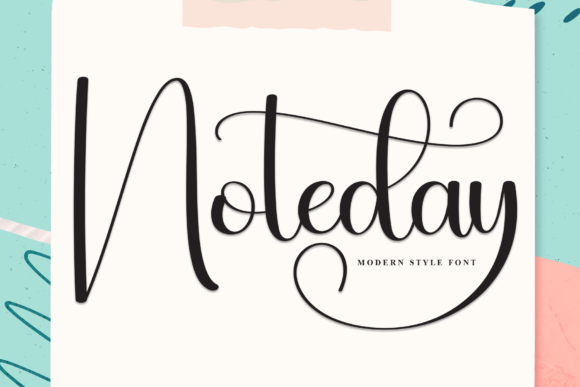
Noteday lives in the sweet spot between elegance and usability. Its strokes flow with confident rhythm—slightly tapered, gently modulated, with subtle contrast that gives it warmth without sacrificing clarity. It’s not overly ornate like some calligraphy fonts that drown in swashes, nor is it so minimal it feels cold. There’s a soft confidence to Noteday—a quiet luxury that says “handmade with care” before a single word is read. That’s why it works so well for physical products where perceived quality directly influences customer trust and pricing power.
For handmade sellers, readability at small sizes is non-negotiable—and Noteday delivers. I’ve tested it down to 8pt on matte sticker paper (with my Silhouette Cameo 4), and the lowercase ‘a’, ‘e’, and ‘s’ retain distinct shapes without merging. That means your lavender soap labels stay legible, your mini tea bag tags hold charm at 10mm height, and your digital printable quote cards render crisply—even when customers print them at home on standard copy paper. The uppercase letters have gentle entry and exit strokes that guide the eye smoothly, making Noteday ideal for short, impactful phrases: “Hand-Poured”, “Made With Love”, “Small Batch”, or “Est. 2022”.
Where Noteday truly shines is in display use—moments when typography becomes part of the product itself. Think farmhouse-style wooden signs with “Gather Here” laser-cut in Noteday; wedding welcome boards where the couple’s names curve gracefully across reclaimed wood; holiday packaging stamped with “Joyful Giving” in gold foil; or printable wall art designed for Etsy buyers who want instant-download sophistication. Because Noteday balances flourish with restraint, it photographs beautifully—no pixelation, no awkward gaps, no unintended breaks in stroke continuity.
It’s also a smart choice for digital printables and templates. As a creator of weekly planner pages and habit trackers, I use Noteday for section headers (“This Week”, “Gratitude Log”, “Goals”) because it adds personality without competing with functional layout. Its natural rhythm supports visual hierarchy—readers instantly recognize headings as distinct from body text, even when paired with a clean sans serif like Montserrat or Inter. And yes—it pairs *exceptionally* well with those: try Noteday for titles + a light-weight sans serif for captions or instructions. For vintage-leaning stationery, pair it with a delicate serif like Playfair Display (light weight) for balance and contrast.
When working with cutting machines, keep these practical tips in mind: avoid using Noteday for full paragraphs or dense blocks of text—it’s a display font, not a text font. Stick to headlines, names, short quotes, and decorative accents. Always convert to outlines before sending to your machine, especially if using swashes or alternate characters. Noteday includes stylistic alternates and ligatures (like the elegant “fl” and “ct” connections), which add polish—but test them first on your material. Some swashes look stunning on vinyl decals but may snag during weeding if too fine.
File-wise, Noteday comes in OTF and TTF formats—both fully compatible with Cricut Design Space, Silhouette Studio, Canva Pro, Adobe Illustrator, and Affinity Designer. If you’re creating SVG bundles for Etsy, the OpenType features make it easy to build layered designs with consistent line weight and spacing. While Noteday focuses on English-language use (with full Latin-1 support), it handles common accented characters used in French, Spanish, and German—useful for bilingual boutique labels or international wedding stationery.
Licensing matters—and Noteday is a commercial font designed for real business use. You’re fully covered to use it in physical products (candle labels, greeting cards, embroidered patches), digital downloads (printable planners, Canva templates, SVG files), client work (logo design for local boutiques), and merchandise (tote bags, ceramic mugs, t-shirts). Just be sure to review the license terms for extended use cases like app integration or large-scale branding systems—most crafters won’t need those, but it’s always wise to double-check.
I reach for Noteday most often when I want a project to feel intentional—not just pretty, but *considered*. Like when I designed a set of seasonal tea blend labels last fall: “Spiced Apple Cider”, “Maple Pecan Chai”, “Cranberry Clove”—all in Noteday, paired with a warm charcoal sans serif for origin notes and ingredients. Customers commented on how “cohesive” and “premium” the packaging felt—even though it was printed on affordable kraft sticker paper. That’s Noteday’s quiet superpower: it elevates materials, reinforces brand voice, and helps your handmade goods stand out in a crowded marketplace.
Whether you're building a cohesive label system for your small-batch skincare line, designing a wedding suite that balances romance and modernity, or creating best-selling digital wall art for Etsy shoppers, Noteday brings consistency and charm without compromise. It’s the kind of script font that doesn’t shout—but makes people pause, smile, and remember your name.