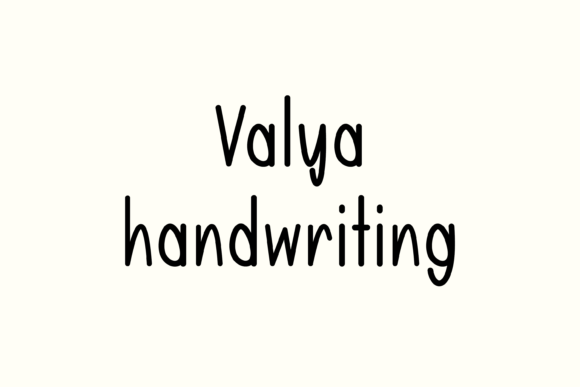
Valya Handwritten Font for Crafters & Sellers
If you’ve ever spent 20 minutes scrolling through font libraries trying to find that *just-right* handwritten typeface—one that feels personal but still prints cleanly, whimsical but never messy—then Valya is the quiet little joy you didn’t know your shop needed. As someone who designs printable planners, hand-labels candles and soaps, cuts vinyl for boutique tags, and builds digital templates for Etsy, I test fonts on real production lines—not just mockups. Valya passed every test: it cuts crisply on my Cricut Maker, holds detail at 8pt on product stickers, and adds warmth to wedding welcome boards without sacrificing readability.
Valya is a friendly, simple handwritten font with gentle bounce and subtle quirks—like a thoughtful note from a friend who knows how to spell “cozy” and also owns a nice pen. It’s not overly ornate or script-heavy, which means it avoids the common pitfalls of many display fonts: tangled connections, inconsistent spacing, or letters that vanish when scaled down. That simplicity is why it works so well across physical and digital craft projects—from laser-cut wooden signs to SVG files for Silhouette users.
For handmade labels, Valya shines where personality matters most. Think soy candle jars with “Lavender + Rain” in soft gray ink, or artisanal honey bottles labeled “Small Batch • Wildflower” in warm sepia. Its open letterforms and balanced x-height mean even tiny 6mm sticker text stays legible under glass or in natural light. On fabric—whether heat-pressed onto linen tea towels or screen-printed on organic cotton totes—Valya keeps its charm without bleeding or pixelating.
Invitations and wedding stationery are another sweet spot. Unlike some script fonts that feel too formal or too fussy, Valya brings approachable elegance. Use it for names and headlines (“Emma & Leo • June 15”), then pair it with a clean sans serif (like Montserrat or Inter) for addresses, RSVP details, and timelines. That contrast gives your suite visual hierarchy *and* professionalism—exactly what couples look for when investing in custom paper goods.
Seasonal craft designs benefit especially from Valya’s light-hearted energy. Try it on holiday gift tags (“Hand-Poured • Made With Love”), Easter egg hunt signs (“Find the Golden Egg!”), or farmhouse-style wall art (“Gather Here”). Its slight irregularity reads as human-made—not AI-generated or mass-produced—which aligns perfectly with the values your customers associate with handmade and small-batch goods.
Readability is where Valya stands out among Script Amp fonts. It’s designed as a display font, not body text—so skip using it for full paragraphs or ingredient lists. But for short phrases, titles, names, and decorative accents? Absolutely ideal. I use it for planner cover titles (“My Cozy Year”), printable quote cards (“Breathe Deeply”), and even mug mockups where the font needs to pop against ceramic curves. Just avoid cramming more than 3–4 words per line at small sizes; let the rhythm breathe.
Cutting machines love Valya too. The outlines are smooth, with no overlapping paths or stray nodes—critical when prepping SVGs or DXF files. No need to manually simplify or outline strokes before sending to your Silhouette Cameo or Cricut Design Space. And because it’s built with consistent spacing and generous letterfit, your vinyl transfers align cleanly, even on curved surfaces like apothecary jars or wine glasses.
Font pairing is intuitive: Valya plays beautifully with minimalist sans serifs for balance, or with understated serifs (like Lora or Merriweather) for vintage-leaning printables. Avoid pairing it with other highly decorative scripts—that creates visual competition. Instead, lean into contrast: soft script + sharp geometry, warmth + structure, hand-drawn + precision. That duality strengthens your brand identity and makes your templates feel intentional, not accidental.
While the product description notes Valya is “simple and friendly,” what really matters for sellers is what’s *in the file*. Look for OpenType features like stylistic alternates and ligatures—they add subtle polish to digital downloads and help avoid repetitive letter combos in longer phrases. If multilingual support is included (e.g., extended Latin characters), that expands your reach for international printable customers or bilingual wedding suites. File formats matter too: OTF and TTF are must-haves for compatibility; WOFF/WOFF2 only matter if you’re building web-based design tools.
And yes—commercial licensing is non-negotiable. Valya is a premium font built for makers who sell. That means you can confidently use it on physical products (stickers, mugs, apparel), digital downloads (PDF planners, Canva templates), client work (logo concepts, packaging mockups), and SVG bundles sold on Etsy or Creative Market. Just double-check the license covers *your* use case—especially if you’re bundling fonts into editable design assets or reselling them as part of a template subscription.
Ultimately, Valya isn’t about trend-chasing. It’s about consistency—the kind that makes customers pause mid-scroll because your candle label feels familiar, warm, and trustworthy. It’s the font that helps your “Thank You” card stand out in a stack of receipts, or turns a basic chalkboard sign into something people photograph and tag. In a market crowded with flashy fonts and generic scripts, Valya earns its place by being quietly excellent: readable, reliable, and full of heart.
Whether you’re printing 500 wedding menus or designing one-of-a-kind planner pages for your shop, Valya doesn’t shout—it invites. And in handmade commerce, that invitation is everything.